
Automated report. This article was drafted with AI assistance from the sources listed below, without a human writing step. Law Week labels every article produced this way. A person is answerable for it: if something here is wrong, write to editor@law-week.com and we will correct it on the page and say what changed.
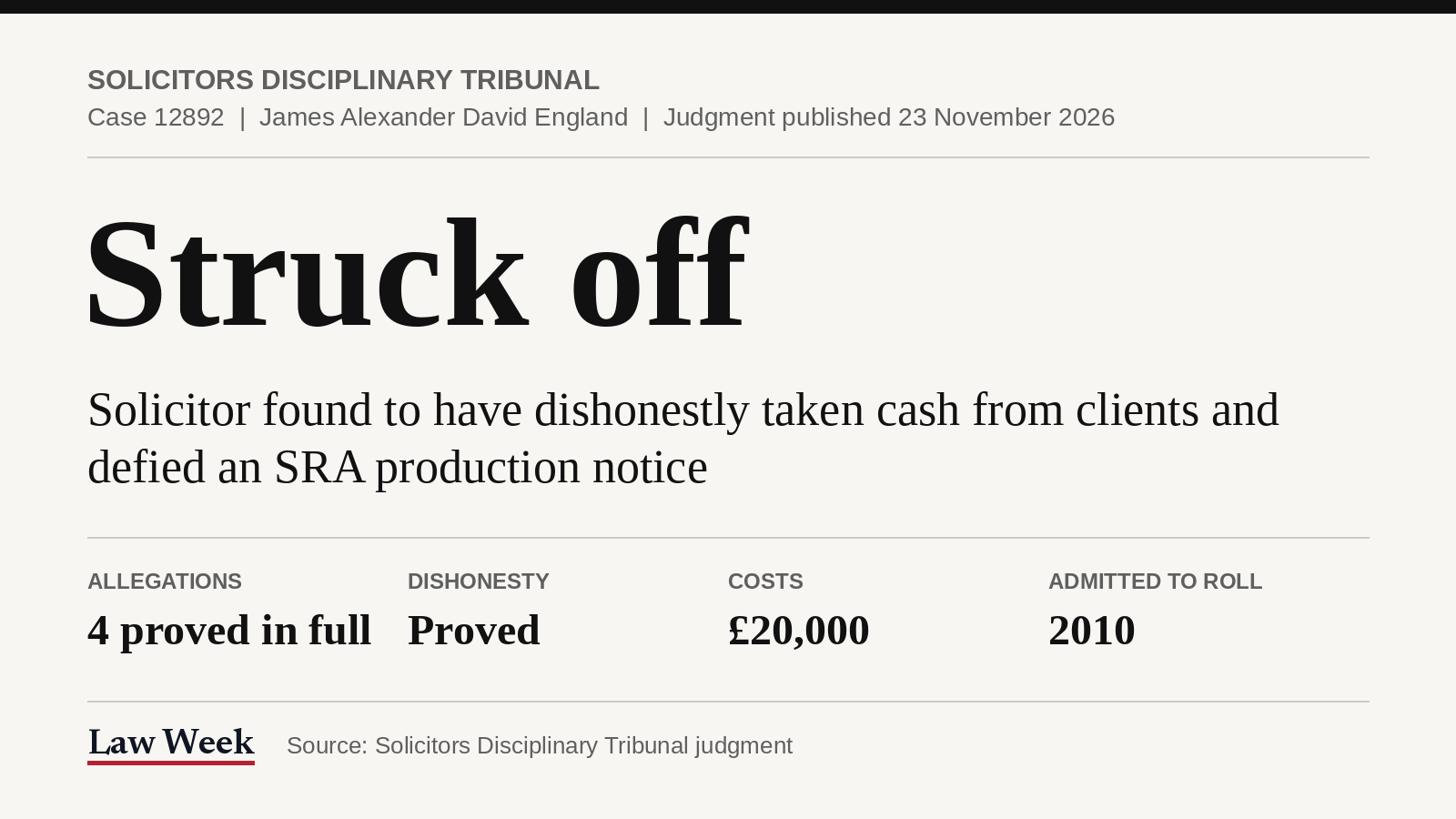
The Solicitors Disciplinary Tribunal has struck off James Alexander David England, former Head of Family Law at Phillips Solicitors, after finding he dishonestly obtained money from three clients and persistently failed to comply with a Solicitors Regulation Authority production notice. The decision was published on 23 November 2026.
The tribunal found allegations 1.1, 1.2 and 1.3 proved in their entirety, concluding that Mr England dishonestly obtained £250 from a client he described as Client A as purported court fees, and at least £1,020 from a client described as Client B as purported fees for the firm’s work. He also inappropriately requested and received £100 from a client described as Client C, failed adequately to progress her instructions, and dishonestly represented that her divorce proceedings were progressing when they were not. The tribunal also found allegation 4 proved in its entirety, concerning his sustained failure to comply with an SRA production notice dated 21 March 2023. He was ordered to pay costs of £20,000.
Key points
- The tribunal found breaches of Principles 2, 4 and 5, paragraphs 1.4, 4.2 and 4.3 of the Code, and paragraph 2.3 of the Accounts Rules in relation to the three clients.
- Allegation 4, concerning failure to comply with the SRA’s production notice, was also found proved in its entirety, breaching paragraphs 7.3 and 7.4 of the Code and Principles 2 and 5.
- Two further allegations, numbered 2 and 3, were withdrawn by the Solicitors Regulation Authority during the hearing and were not determined by the tribunal.
- The tribunal assessed Mr England’s culpability as high, finding he was motivated by personal financial gain and that his conduct was deliberate and planned.
- The tribunal ordered Mr England to pay the Solicitors Regulation Authority’s costs fixed at £20,000.
What the tribunal found
The tribunal accepted the evidence of Client A, Client B and Client C in its entirety. It found that Mr England had arranged to meet clients in locations outside the firm’s offices, requested cash payments that were not recorded on the firm’s systems, and failed to issue receipts. In relation to Client C, the tribunal noted a message in which Mr England, asked whether documents were on their way to court, replied “yes all good” despite knowing her matter had not been registered with the firm and no substantive work had been undertaken. The tribunal found that Mr England’s conduct in respect of each client was dishonest, lacked integrity and failed to uphold public trust and confidence in the profession.
On allegation 4, the tribunal found that Mr England’s failure to respond to the production notice, despite further opportunities to comply and a warning of enforcement action, amounted to a failure to cooperate with the SRA’s investigation, impeding its ability to obtain material it sought.
Mitigation and sanction
In a witness statement, Mr England said he considered he had acted honestly throughout his career and took pride in his work for clients. He stated he had not practised since 2023 and did not intend to return to the profession. The tribunal took into account his absence of previous disciplinary matters but found this did not diminish the deliberate dishonesty proved in the proceedings, and did not demonstrate remediation or insight into the impact on clients.
The tribunal considered whether a lesser sanction could meet the seriousness of the misconduct, concluding that no order, a reprimand, a financial penalty, restrictions on practice or suspension would be sufficient given the repeated dishonesty and failure to cooperate with the regulator. It found no exceptional circumstances and determined that striking off was the only appropriate and proportionate sanction.
The hearing and costs
Mr England did not attend the hearing and was not represented. The tribunal was satisfied he had been served with notice in accordance with its rules and proceeded in his absence under Rule 36 of the Solicitors (Disciplinary Proceedings) Rules 2019, having regard to a statement he had submitted acknowledging the tribunal might proceed without him. The Solicitors Regulation Authority applied for costs of £39,592.51; the tribunal reduced this to reflect the withdrawal of two allegations and assessed reasonable and proportionate costs at £20,000, which it ordered Mr England to pay. Mr England may appeal the tribunal’s decision to the High Court.